
New paper published! Assessment of ecological safety and economic efficiency of biosorption technology for soil protection after hostilities
BioResources and Technology Division (BRT) senior researcher Yelizaveta Chernysh and BRT Director Assoc Prof. Dr. Hynek Roubík recently published an article!
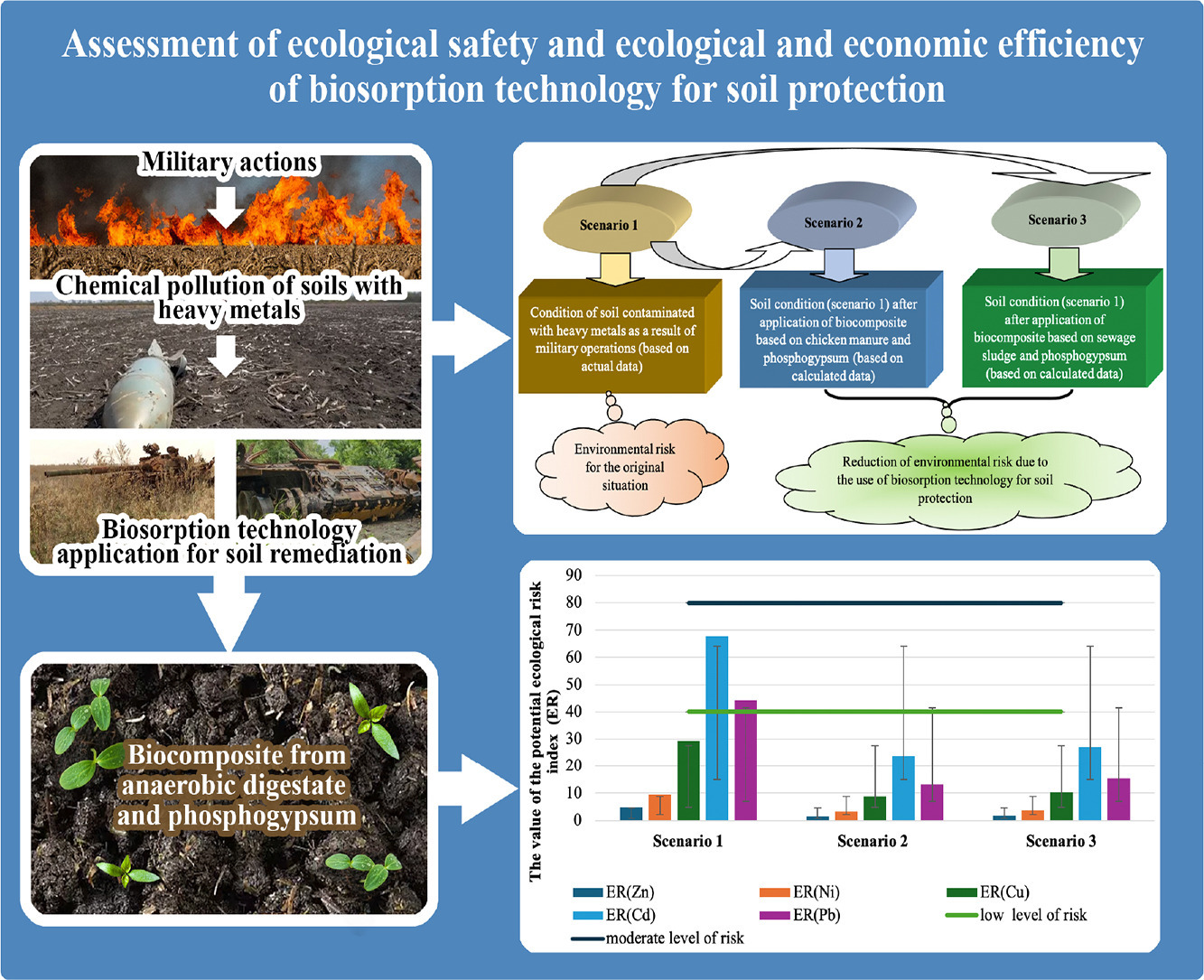
This study addresses the growing ecological risks of chemical soil pollution in Ukraine following military action due to the full-scale Russian invasion. This research evaluates the ecological safety and economic feasibility of biosorption technology in mitigating heavy metal contamination in soils.
The study examined three scenarios to assess ecological risk levels: Scenario 1 analyzed actual soil contamination with five heavy metals (Zn, Cu, Ni, Pb, and Cd), while Scenarios 2 and 3 explored the application of biosorption technology for soil protection. The research introduced an innovative approach to ecological risk assessment, incorporating Bayes’ theorem and a developed set of qualitative and quantitative parameters. By evaluating the efficiency of heavy metal immobilization in the soil using the complex formation indicator and fluorescent properties of digestate organic matter, the study demonstrated a reduction in ecological risk from moderate to low in both biosorption scenarios. Risk assessment based on Bayes’ theorem indicated a shift from high to medium risk levels.
The study also assessed the ecological and economic efficiency of the proposed technology based on a methodology for calculating ecological damage after hostilities. The results highlight the potential for biosorption technology to be integrated into a comprehensive soil restoration framework, providing a cost-effective solution for mitigating heavy metal contamination in conflict-affected regions. Read the full paper below!
Citation: Skvortsova P., Ablieieva I., Boiko A., Chernysh Y., Bataltsev Y., Kuzomenska K., Roubík H., Assessment of ecological safety and economic efficiency of biosorption technology for soil protection after hostilities. Journal of Hazardous Materials Advances. Volume 18. 2025. https://doi.org/10.1016/j.hazadv.2025.100677
For more details on BRT, follow us on social media for regular updates and highlights.