

New Paper published! Predictive Modeling of Bacterial Inactivation With Hydrogen Peroxide Over a Cobalt Ferrite Catalyst
Researchers from the BioResources and Technology (BRT) division at the Faculty of Tropical AgriSciences, Czech University of Life Sciences Prague, BRT Director Assoc. Prof. Dr. Hynek Roubík and BRT Communications Manager Dr. Stacy Hammond recently co-authored an article in ChemPhysChem. The research explores how machine learning can improve the prediction and control of bacterial inactivation during advanced water treatment.
The article, “Predictive Modeling of Bacterial Inactivation With Hydrogen Peroxide Over a Cobalt Ferrite Catalyst,” was authored by Viktor Husak, Nazarii Danyliuk, Hynek Roubík, Olena Bobrova, Stacy Hammond, and Alexander Shyichuk.
Combining advanced oxidation with machine learning
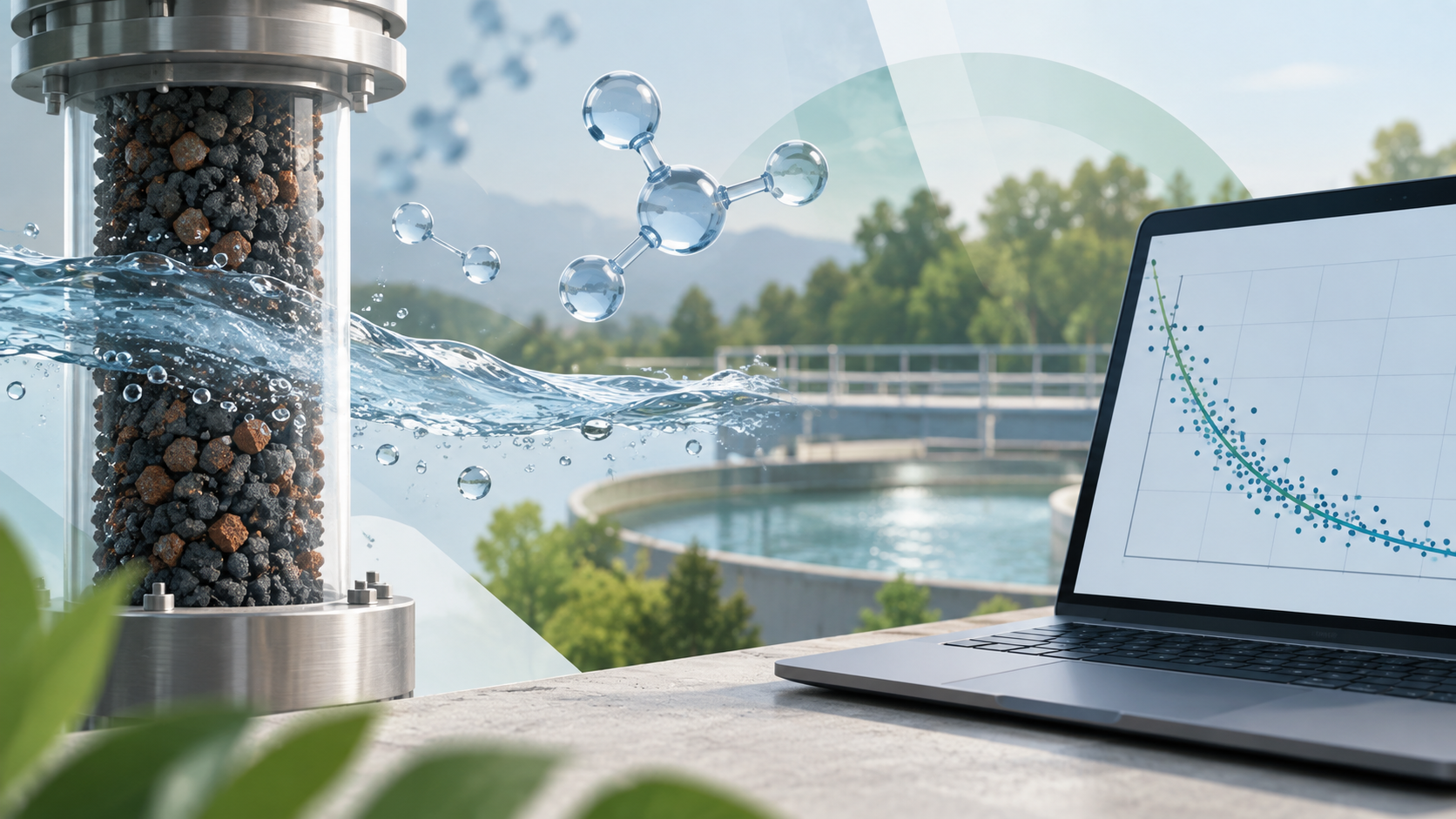
The study investigated bacterial disinfection using hydrogen peroxide (H2O2) activated by a cobalt ferrite catalyst in a continuous-flow packed-bed reactor. Activation of hydrogen peroxide generates highly reactive hydroxyl radicals that effectively inactivate bacteria.
Because bacterial inactivation under these conditions follows complex and highly nonlinear kinetics, the researchers compared conventional kinetic approaches with 10 machine-learning algorithms. The experimental dataset covered different H2O2 concentrations, initial Escherichia coli loads and contact times.
Among the tested machine-learning approaches, Gradient Boosting (GB) and Random Forest (RF) provided the strongest predictive performance. The researchers subsequently combined the two approaches into a hybrid GB + RF model. This combined model achieved average prediction errors of ±10% or less at low-to-moderate peroxide concentrations and was independently validated using experimental data at an H2O2 concentration not included in the model training.
Towards smarter water-treatment systems
The results demonstrate the potential of data-driven modelling to support the operation of catalytic water-disinfection systems. Instead of relying exclusively on conventional kinetic equations, machine-learning models can account for complex interactions between initial bacterial concentration, hydrogen peroxide dose and contact time.
Such predictive tools could ultimately help determine the operating conditions required to achieve a desired level of bacterial reduction, supporting the development of more efficient and intelligently controlled water-treatment processes. The authors nevertheless emphasise that further validation is needed before extrapolating the model beyond the reactor configurations, water matrices and operating ranges investigated in the study.
The research brings together expertise from institutions in the Czech Republic, Ukraine and Poland, highlighting the value of international collaboration at the interface of environmental biotechnology, materials science and data-driven process modelling.
For more details on BRT activities, subscribe to our newsletter or follow us on social media for regular updates and highlights!