New Paper published! Multi-sensor integration and cloud-native AI for climate-smart agricultural monitoring: A systems framework
BRT members Postdoctoral Researcher Dr. Bojana Petrovic, Director Hynek Roubík, Senior Researcher and Advisor Dr. Jan Banout and Project Manager Dr. Jan Staš from the Faculty of Tropical Agrisciences (FTZ) at the Czech University of Life Sciences Prague (CZU) recently published an article in Computers and Electronics in Agriculture.
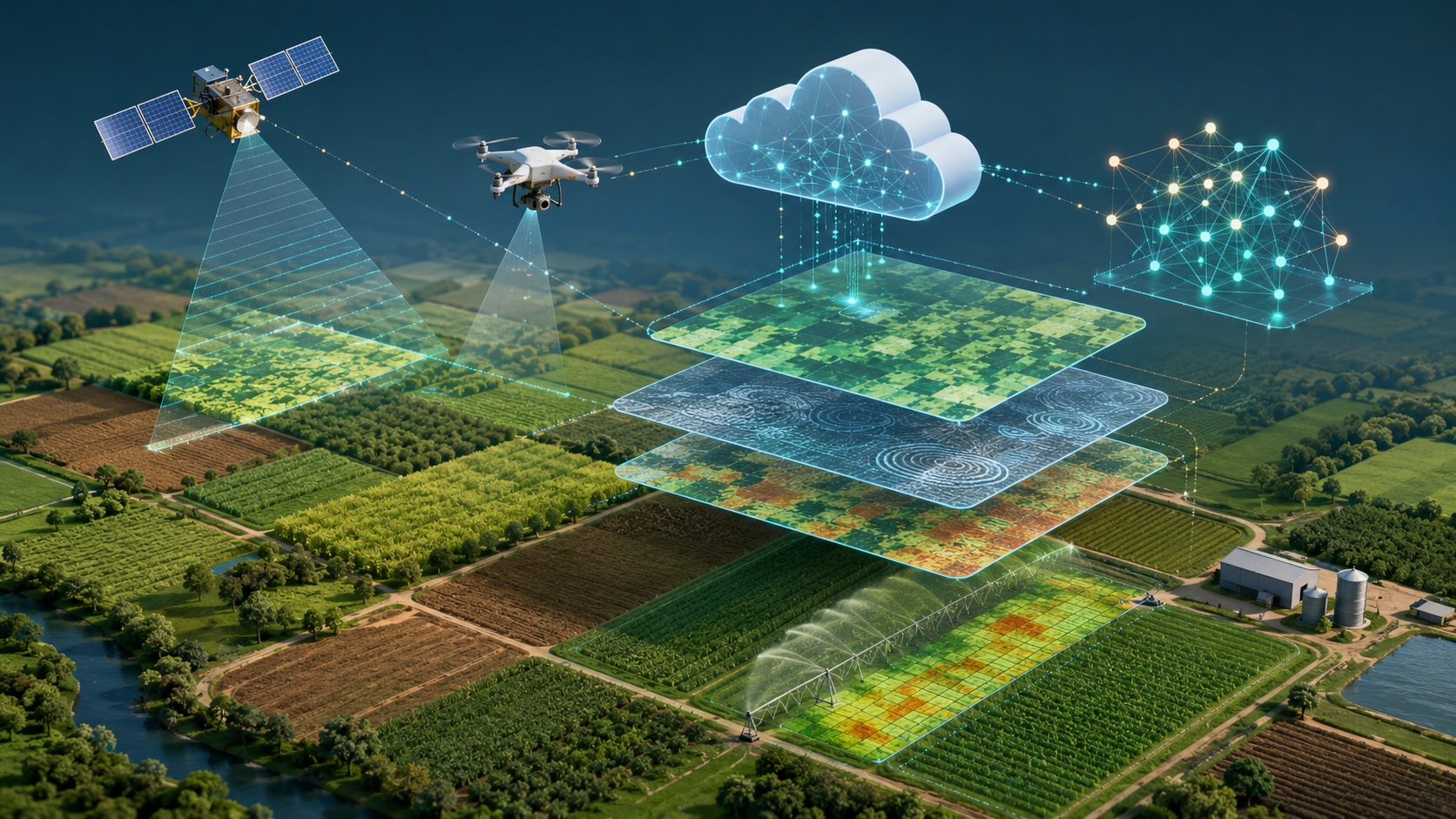
How can satellite observations, machine learning and cloud computing be combined to help agriculture respond to climate change? A new review led by BRT researcher Bojana Petrovic brings these technologies together in a unified framework for practical agricultural monitoring and decision support.
From separate tools to one connected system
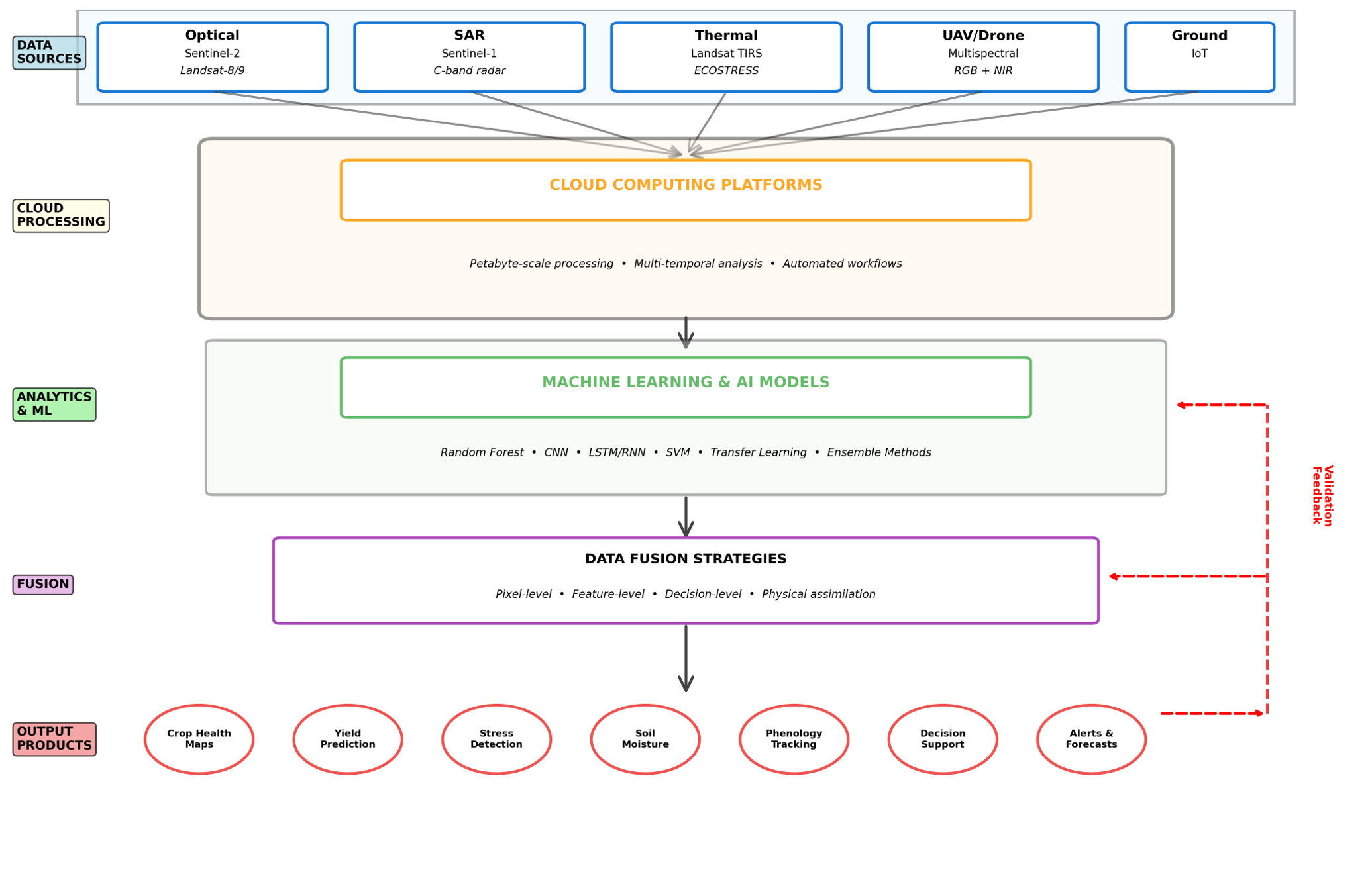
This open-access article reviews developments in remote sensing for climate-smart agriculture between 2000 and 2025. Drawing on 120 core peer-reviewed studies, the authors propose a five-layer computational framework, illustrated below, that connects data acquisition, cloud processing, machine-learning analytics, data fusion and decision-support outputs.
This systems perspective is important because the value of agricultural monitoring does not come from a single sensor or algorithm. Reliable information depends on how different data sources and analytical steps work together, from collecting observations to translating results into timely and usable guidance for farmers, advisers and policymakers.
What the evidence shows
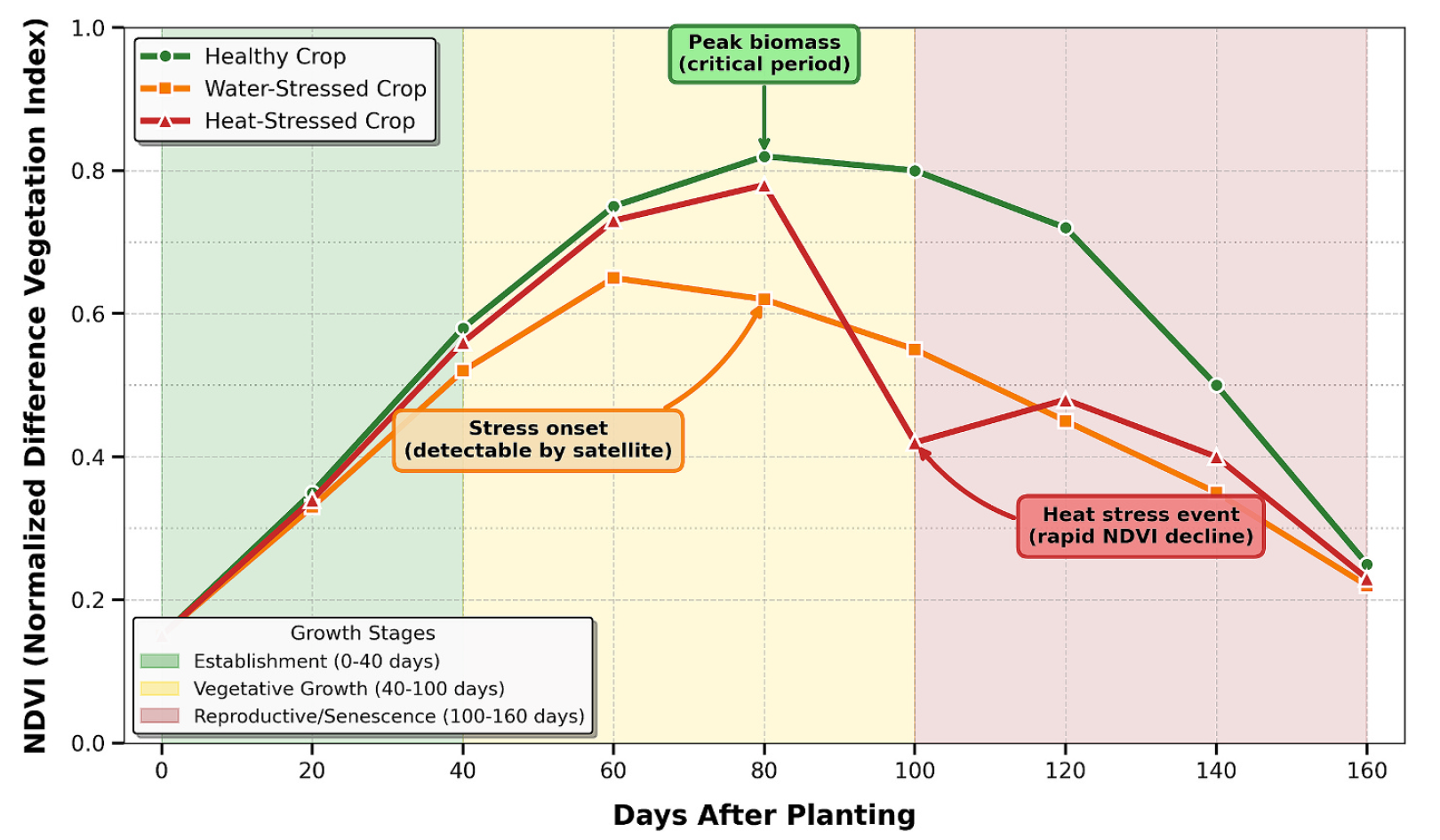
The review shows that combining sensors can make monitoring more robust than relying on one source alone. For example, integrating optical Sentinel-2 imagery with Sentinel-1 radar data has achieved classification accuracies of up to 89% in cloud-prone regions, compared with approximately 76% for optical data alone. Machine-learning yield models frequently improved predictive performance by 5–20% in R2 under data-rich conditions, while multi-temporal approaches enabled crop stress to be detected two to four weeks before visible symptoms appeared.
Cloud-based platforms such as Google Earth Engine further reduce computing barriers, making it possible to process extensive satellite archives and monitor agricultural conditions from individual fields to entire regions. Together, these capabilities can support earlier stress detection, more precise use of water and other inputs, yield forecasting and evidence-based climate adaptation.
Technology still needs local evidence
The authors also underline that advanced technology is not automatically transferable or reliable everywhere. Machine-learning performance depends on the quality of calibration data, and models developed in one region may perform poorly in another. Limited ground-truth data, inconsistent reporting and reproducibility gaps remain major constraints, particularly in smallholder-dominated and data-scarce agricultural systems.
The paper therefore calls for interoperable, reproducible and transferable monitoring systems, supported by stronger local validation and outputs that users can readily understand and apply. The proposed framework offers a practical blueprint for national and regional programmes seeking to turn Earth-observation data into dependable support for food security and climate adaptation.
A collaborative BRT contribution
The review was led by Bojana Petrovic and co-authored by BRT members Hynek Roubík, Jan Staš and Jan Banout, together with László Csambalik from the Hungarian University of Agriculture and Life Sciences and Turgay Dindaroglu from Karadeniz Technical University. The research was supported by the Horizon Europe BIO-CAPITAL project (Grant Agreement No. 101135150), coordinated by BRT at the Czech University of Life Sciences Prague.
Citation: Petrovic, B., Roubík, H., Csambalik, L., Dindaroglu, T., Staš, J., & Banout, J. (2026). Multi-sensor integration and cloud-native AI for climate-smart agricultural monitoring: A systems framework. Computers and Electronics in Agriculture, 253, 112182. https://doi.org/10.1016/j.compag.2026.112182
For more details on BRT activities, subscribe to our newsletter or follow us on social media for regular updates and highlights!