
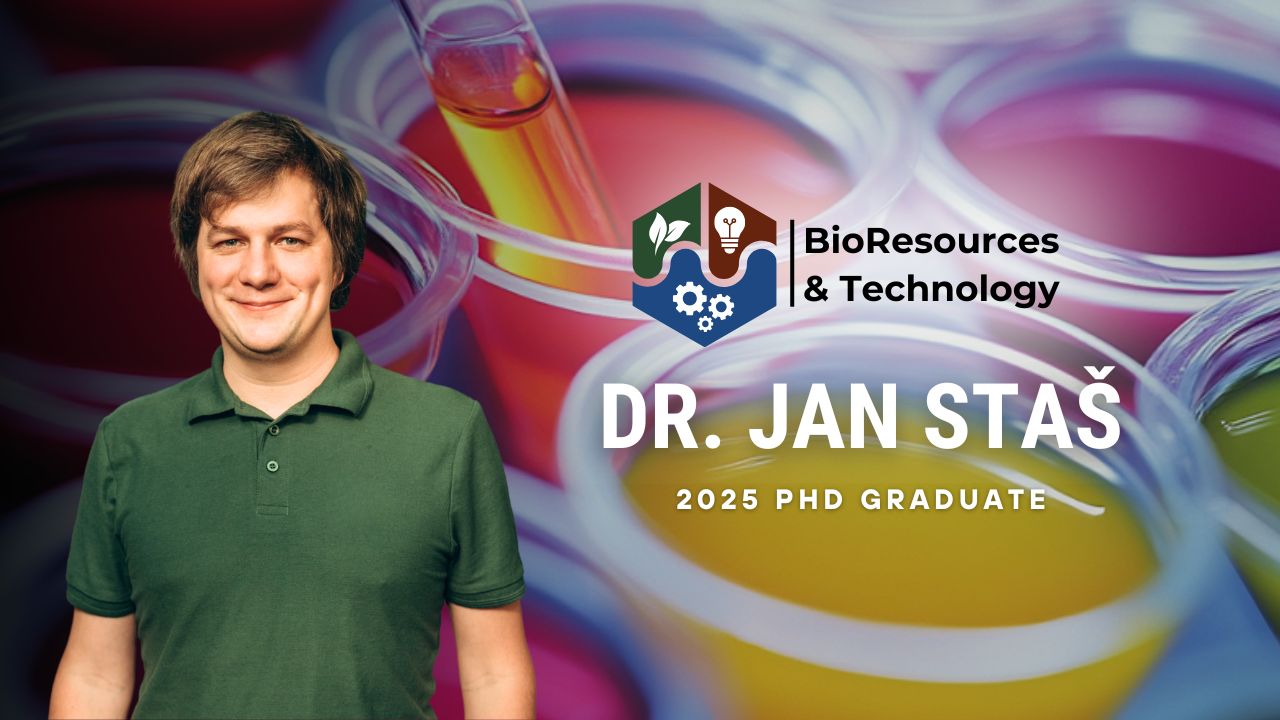
Introducing 2025 PhD graduate, Dr. Jan Staš
Dr. Jan Staš earned his Ph.D. in Tropical Agrobiology and Bioresource Management under the supervision of Professor Jan Banout at the Czech University of Life Sciences Prague (CZU). His research focused on developing natural plant-based solutions to prevent spoilage in beverages, with a particular emphasis on tropical fruit juices. His research topic was “In vitro growth-inhibitory effect of plant-derived products against beverage-spoiling microorganisms.”
Dr Staš has actively participated in more than 10 development projects and international conferences, and completed 3 research internships (Thailand, Vietnam) during his 8 years of doctoral studies. He has been a member of the BioResources and Technology (BRT) division and the Food Security Research Group at FTZ since the first year of his studies.
To get more insights into Dr. Staš's academic journey, our BRT Communications team conducted an interview to capture his thoughts and share his story.
Question 1: How does it feel to have successfully defended your doctoral dissertation?
Dr. Staš: I am absolutely delighted and relieved. Successfully defending my dissertation is the culmination of many years of dedicated work and passion. It feels incredibly rewarding to see that all the long days in the lab and the field have paid off. More importantly, I feel proud that my research – which brings tropical science perspectives into a European setting – is now out there contributing knowledge. It’s a great feeling to know that our findings on plant-based preservatives can help address real-world challenges, like helping small-scale juice processors who don’t have access to synthetic preservatives keep their products fresh naturally. It hasn't fully sunk in yet, but I’m incredibly grateful to my supervisor, colleagues, and family for their support throughout this journey. Overall, it’s a mix of happiness, gratitude, and excitement for what comes next.
Question 2: Can you share pivotal moments from your academic journey that you believe were crucial in successfully defending your doctoral dissertation?
Dr. Staš: There were several pivotal moments. One was definitely my field experiences in the tropics. For example, working on fruit processing projects in places like Cambodia, Ethiopia, and Zambia early on opened my eyes to the on-the-ground issues local producers face. Seeing farmers struggle with spoilage because they can’t find or afford synthetic additives made me realise how crucial my research could be for them. Another key moment was in the lab when I successfully modified the broth microdilution assay to test plant extracts or other natural compounds directly in real fruit juice. That breakthrough proved we could reliably measure natural antifungal effects in an actual juice environment, which gave me huge confidence in our approach. Also, collaborating across different departments was critical – working with experts in microbiology, food technology, and ethnobotany provided fresh perspectives and spurred innovative ideas. Each of these moments built up my skills and resolve, ultimately helping me stand strong during the defence.
Question 3: Reflecting on the process, what were the significant challenges you encountered while writing your dissertation and defence phases, and how did you navigate through them?
Dr. Staš: One significant challenge was methodological. At the start, there was no efficient standard way to test natural preservatives in real juice matrices – fruit juices are complex systems (acidic, colored, etc.), which made things complicated. I spent a lot of time adapting methods: We modified the traditional microdilution technique so we could test plant compounds directly in real fruit juice instead of just using artificial lab media. It took plenty of trial and error, but persistence paid off. Another challenge was dealing with opaque juices where our usual turbidity-based measurements of yeast growth wouldn’t work. To overcome that, we adapted another method, the MTT viability assay, which allowed us to quantify yeast inhibition even in cloudy juices. On a personal level, juggling multiple projects and fieldwork alongside writing was tough. I navigated it by staying organised and keeping the big picture in mind – remembering that each challenge was a step toward our goal of improving food preservation for small producers. Support from my supervisors and colleagues was also invaluable – their willingness to brainstorm solutions kept me resilient through the process.
Question 4: Balancing academic commitments, personal life, and other responsibilities can be demanding. How have you managed to strike that balance while working on your dissertation?
Dr. Staš: Balancing a PhD with personal life is definitely challenging, and I won’t pretend it was always perfect. What helped was truly loving what I do – my research often took me to the field in tropical countries and into collaborations with diverse teams, which I found energising rather than draining. I also learned to manage my time. I set aside dedicated slots for writing and lab work, but I also made sure to carve out downtime to recharge, whether that meant enjoying a weekend offline or pursuing a hobby. The support of friends, family, and colleagues was crucial; their understanding and encouragement kept me grounded when things got intense. Being part of a team like BRT provided a supportive community where everyone understands the value of work-life balance. In the end, passion for the research kept me going, but I also recognised when to step back and rest – finding that balance was key to staying productive and sane.
Question 5: What valuable advice would you offer for fellow doctoral candidates preparing for their dissertation defence?
Dr. Staš: My advice would be to prepare diligently and stay passionate. For the defence itself, know your thesis inside out, but also remember that you are the expert on your topic – take confidence in how much you’ve learned. Practice your presentation multiple times, perhaps with labmates, and try to anticipate the questions that might come up. During the defence, be clear and concise in explaining your work, and let your enthusiasm for your research shine through. Beyond the defence, my broader advice is to choose a research topic you truly care about. There will undoubtedly be setbacks and tough days, and it’s your passion for the subject that will fuel your resilience when things get difficult. In my case, knowing that our work could improve food preservation for small communities kept me motivated even when experiments didn’t go as planned. So stay curious, be persistent, and don’t be afraid to ask for help from mentors or peers – it’s a challenging journey, but your dedication and love for your work will carry you through.
Question 6: Do you have any recommendations for current and future BRT students?
Dr Staš: For students in the BRT division, I’d recommend making the most of the breadth of resources and expertise around you. One of the strengths of BRT is its multidisciplinary nature – don’t hesitate to collaborate with colleagues from different fields or departments. In my experience, some of the best ideas emerged from cross-disciplinary conversations. Also, take every opportunity to gain practical experience. If there’s a chance to join a field project or undertake an internship abroad, go for it – those experiences are invaluable and will connect your research to real-world impact. Stay curious and proactive: attend workshops, present at conferences, and be open to learning beyond your immediate focus. And finally, remember why you’re in this field. BRT/FTZ is all about developing sustainable solutions for global challenges, so keep that bigger mission in mind. Keeping a sense of purpose will not only inspire your research but also carry you through the tougher times.
Question 7: Now that you have reached this momentous achievement, what are your plans for the future?
Dr. Staš: Moving forward, I’m excited to continue working on applied, impact-driven development projects in the tropics. My passion lies in taking the kind of research I did in the lab and translating it into real-world solutions for communities. In the near future, I plan to expand our work on natural preservatives – perhaps by piloting these plant-based solutions with small juice producers in Africa or Southeast Asia to see how they perform on the ground. I also intend to stay involved in broader multidisciplinary projects beyond food preservation, because issues like food security connect with renewable energy, agriculture, and community development. Ultimately, I see myself at the intersection of academia and practical development work. Whether through continuing research collaborations or working with international organisations, I want to ensure that the knowledge we generate directly benefits people in tropical regions. I’m really looking forward to building on this momentum and contributing to sustainable development in a hands-on way.
For more details on BRT activities, subscribe to our newsletter or follow us on social media for regular updates and highlights!