

new paper published! Biocontrol, plant growth-promoting, and bioremediation potential of Aeromonas veronii CMF from the gut of Chrysomya megacephala
BioResources and Technology Division (BRT) Postdoctoral Researcher Dr. Sandipan Banerjee and BRT Director Assoc. Prof. Dr. Hynek Roubík recently published an article in Microbiology Spectrum (American Society for Microbiology).
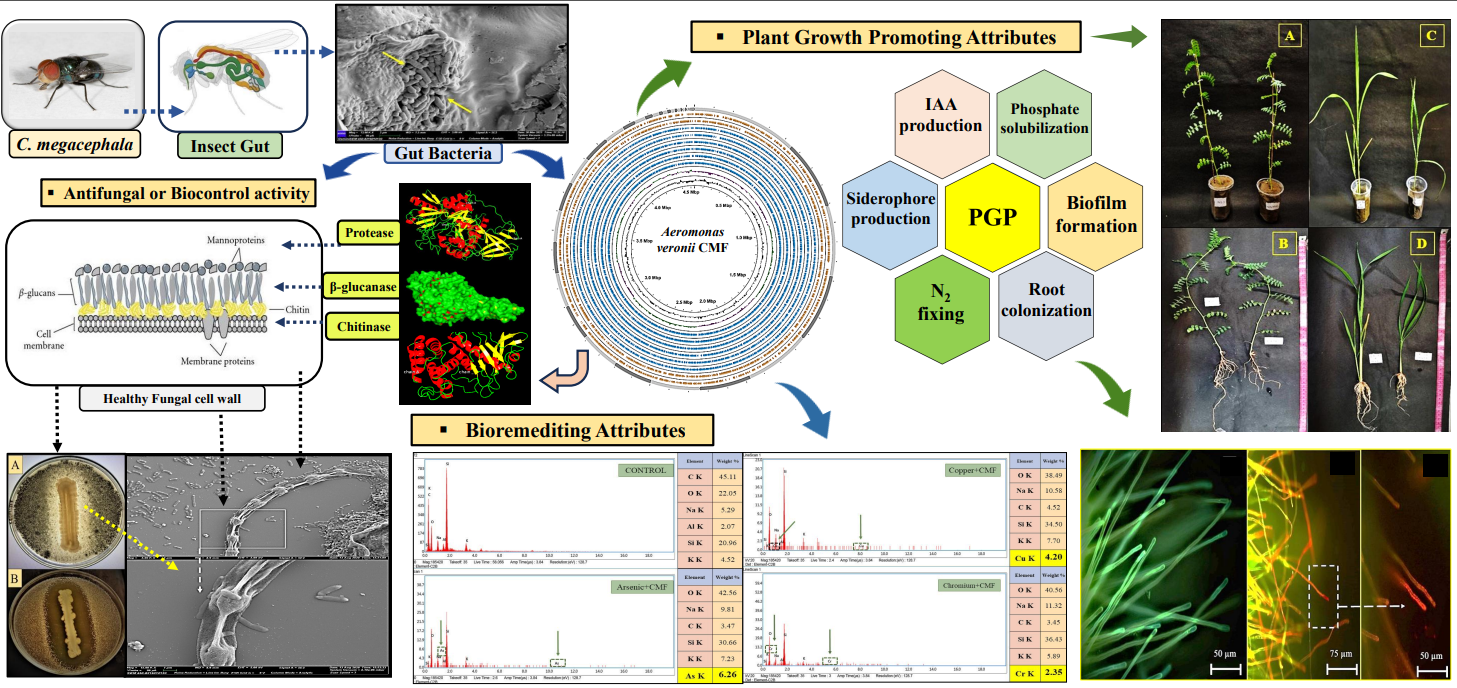
In this study, the gut system of the chitinivorous insect Chrysomya megacephala was purposefully targeted to explore previously uncharacterized microbial resources, based on the rationale of its natural feeding habits. A phytobeneficial bacterial strain, Aeromonas veronii CMF, was successfully isolated and characterized using genomic approaches, with findings corroborated by phenotypic and biochemical analyses. The gut isolate A. veronii CMF was confirmed to be non-pathogenic, as evidenced by negative hemolysis and DNase test results.
Antifungal enzyme production by CMF was quantified as 22.14 ± 2.12, 16.09 ± 0.476, and 1.89 ± 0.46 U/mL for chitinase, protease, and ß-1,3-glucanase, respectively. Furthermore, both in vitro and in vivo studies demonstrated the effective utilization of these gut bacterial attributes against as many as nine plant pathogenic fungi. The strain exhibited plant growth-promoting (PGP) and root-colonizing activities in Cicer arietinum and Oryza sativa IR36, along with resistance to, removal of, and bioaccumulation potential for heavy metal(loid)s (HMs), including As3?, Cd2?, Cr6?, Cu2?, Pb2?, and Hg2?.
Genomic and phenotypic investigations further confirmed the characterization of antifungal enzymes (chitinase, protease, and ß-1,3-glucanase) and PGP traits such as indole-3-acetic acid (IAA) and siderophore production, phosphate solubilization, nitrogen fixation, biofilm formation, and root colonization. Root colonization capabilities were substantiated through scanning electron microscopy and fluorescence microscopy observations. Additionally, CMF demonstrated removal efficiencies of 51.29 ± 2.74%, 47.00 ± 2.84%, and 25.15 ± 3.17% for arsenic, chromium, and copper, respectively, in response to exposure to 1000 µg/mL of HMs.
Overall, the present study highlights the potential of the gut symbiont CMF to respond effectively to both biotic and abiotic stresses while exhibiting PGP attributes relevant to sustainable agriculture. Based on its multidimensional gut symbiotic characteristicst—validated through integrated genomic and phenotypic analyses—it is suggested that this gut symbiont can perform host-beneficial functions within the plant rhizosphere, conceptualized here as the “plant gut system,” and consequently act as a “plant gut symbiont.”
Citation: Banerjee S, Saha KK, Pramanik K, Biswas R, Parveen M, Balachandran S, Roubík H, & Mandal NC (2025). Biocontrol, plant growth-promoting, and bioremediation potential of Aeromonas veronii CMF from the gut of Chrysomya megacephala. Microbiology Spectrum. https://doi.org/10.1128/spectrum.01622-25
For more details on BRT activities, subscribe to our newsletter or follow us on social media for regular updates and highlights!